Understanding Japanese pronouns, what they communicate, and how to find your own voice in Japanese.
One of the more interesting questions I get from students learning Japanese is which word they should use when referring to themselves.
Most Japanese textbooks introduce you to watashi (私). If you’re lucky, they might also introduce you to boku (僕) and ore (俺). But then you start watching anime, reading manga, or actually talking to Japanese people, and suddenly everyone seems to have a different way of saying “I.”
You hear uchi, jibun, washi, and occasionally some guy running around calling himself sessha.
So, which one are you supposed to use?
Well, that depends. What kind of Japanese do you want to speak? Who are you speaking to? What kind of relationship do you have with that person? And, perhaps most interestingly, how do you want to present yourself?
Japanese pronouns are a wonderful example of how learning a language is about much more than learning how to translate words.
Japanese Pronouns Don’t All Mean the Same Thing
Let’s start with a little experiment.
- Watashi wa gakusei desu. 私は学生です。
- Boku wa gakusei desu. 僕は学生です。
- Ore wa gakusei desu. 俺は学生です。
- Atashi wa gakusei desu. あたしは学生です。
- Uchi wa gakusei desu. うちは学生です。
Every one of these sentences can be translated as “I am a student.”
However, every one of these sentences also communicates something slightly different about the person speaking.
While the grammatical information remains the same, the social information changes.
In linguistics, we sometimes talk about indexicality. Put simply, the language we use can point toward information about ourselves beyond the literal meaning of our words.
Think about the difference between someone saying “Hello, everyone,” “Hey, guys,” and “Howdy, y’all.”
They are all greetings, but you probably imagined slightly different people saying each of them.
Japanese first-person pronouns work in a similar fashion. They can communicate things such as:
- Masculinity or femininity
- Formality and politeness
- Age and generation
- Regional identity
- Familiarity with the listener
- Social position
- Personality and self-expression
Notice that I said can. These are associations, not absolute grammatical rules.
With that in mind, let’s get into the good stuff.
The Japanese Pronouns You Should Know
Watashi — 私(わたし)
Feeling: Neutral, standard, composed.
Politeness: Standard to polite.
Common users: Pretty much everyone, depending on the situation.
Watashi is probably the first Japanese pronoun you learned, and for good reason. It is one of the most versatile ways to refer to yourself in Japanese.
In professional and polite situations, watashi is generally gender-neutral. You can use it when introducing yourself, meeting someone for the first time, speaking with a professor, or attending a business meeting.
However, in more casual situations, watashi can carry a slightly feminine association when contrasted with pronouns like boku and ore.
That doesn’t make it a women’s pronoun. It means that its social associations change depending on where and how it is used.
If you’re ever unsure which pronoun to use, watashi is an excellent default.
Example:
Watashi wa John desu.
私はジョンです。
I am John.
Watakushi — 私(わたくし)
Feeling: Formal, refined, professional.
Politeness: Very formal.
Common users: People speaking in formal or professional settings, regardless of gender.
Watakushi uses the same kanji as watashi but is pronounced differently.
You might hear watakushi during a formal speech, a business introduction, an official announcement, or from someone working in a particularly formal customer service environment.
It is not necessarily something you would use while grabbing ramen with your friends.
There is nothing grammatically wrong with doing so, but you might sound like you’re about to deliver a corporate earnings report over your bowl of noodles.
Example:
Watakushi wa Tanaka to moushimasu.
私は田中と申します。
My name is Tanaka.
Boku — 僕(ぼく)
Feeling: Approachable, softer, masculine.
Politeness: Casual to moderately polite.
Common users: Boys, men, and people comfortable with its traditionally masculine associations.
Boku is an interesting pronoun because it occupies a considerable amount of social space.
It is frequently associated with boys and younger men, but plenty of adult men continue to use boku throughout their lives.
Compared to ore, boku generally sounds softer and less assertive. It can also work comfortably alongside polite Japanese, depending on the relationship between the speakers.
Boku is also used by some women and girls, as well as people who prefer a less conventionally feminine way of referring to themselves.
It is not inherently childish, nor does using it necessarily indicate that someone identifies as male.
Example:
Boku wa nihongo ga suki desu.
僕は日本語が好きです。
I like Japanese.
Ore — 俺(おれ)
Feeling: Familiar, assertive, strongly masculine.
Politeness: Casual.
Common users: Primarily men and boys, particularly among friends and family.
Ore is one of the pronouns that Japanese students tend to pick up fairly quickly from anime.
However, ore is not inherently rude, aggressive, or disrespectful.
A man using ore when talking to his wife, brother, or childhood friends may sound perfectly natural. That same man using ore during a formal job interview could make a very different impression.
Ore is strongly associated with masculinity and familiarity. Depending on the speaker and situation, it can also communicate confidence, intimacy, toughness, or solidarity.
The important thing to understand is that ore is not just a cooler version of boku. It carries a different set of social expectations.
Example:
Ore mo iku.
俺も行く。
I’m going too.
Atashi — あたし
Feeling: Relaxed, familiar, feminine.
Politeness: Casual.
Common users: Primarily women and people comfortable with feminine speech associations.
Atashi is closely related to watashi but carries a more distinctly feminine and informal feeling in contemporary Japanese.
It is commonly associated with relaxed conversations between friends and family.
If watashi feels a little too formal or neutral for how you want to present yourself, atashi might feel more comfortable in casual situations.
However, it is not necessarily interchangeable with watashi in professional settings.
Example:
Atashi mo tabetai.
あたしも食べたい。
I want to eat it too.
Uchi — うち
Feeling: Familiar, informal, regional or youthful.
Politeness: Casual.
Common users: Speakers of certain regional dialects, particularly in western Japan, and many younger speakers.
Uchi is one of my favorite examples of why we shouldn’t divide Japanese pronouns into simply masculine and feminine categories.
Uchi has strong associations with the Kansai region and other parts of western Japan, but its use is not limited to those areas.
It has also become a popular form of self-reference among younger female speakers, including those outside of Kansai.
Compared with atashi, uchi can communicate a less traditionally feminine style of speech, although that depends considerably on the community in which it is being used.
Interestingly, uchi can also refer to one’s home, household, company, or the group to which one belongs. Context matters quite a bit with this one.
Example:
Uchi mo sou omou.
うちもそう思う。
I think so too.
Jibun — 自分(じぶん)
Feeling: Straightforward, serious, sometimes disciplined.
Politeness: Context-dependent.
Common users: Various speakers, with associations with sports, military, and other hierarchical environments.
Jibun literally relates to the idea of oneself.
While it is frequently used reflexively, similar to “myself” or “yourself” in English, jibun can also function as a first-person pronoun.
You may encounter this usage among athletes, people in certain professional environments, or people who have simply adopted it as their preferred form of self-reference.
It can carry masculine or disciplined associations, but these are not universal.
Interestingly, in some regional dialects and contexts, jibun can even refer to the person you are speaking to rather than yourself.
Japanese is fun like that.
Example:
Jibun wa mada mada desu.
自分はまだまだです。
I still have a long way to go.
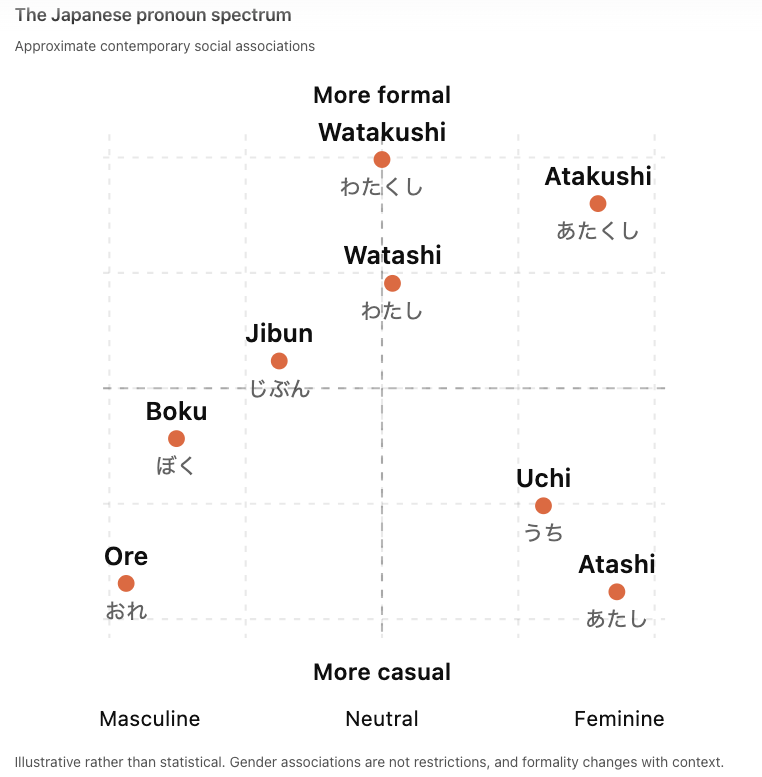
The Japanese Pronoun Spectrum
Instead of thinking about Japanese pronouns as belonging to two separate buckets labeled “men” and “women,” try thinking about them as existing across multiple spectrums.
There is a spectrum of masculinity and femininity, a spectrum of formality, and another relating to familiarity and social distance.
These spectrums overlap, but they are not the same thing.

| Pronoun | Gender association | Formality | General feeling |
|---|---|---|---|
| Watakushi | Neutral | Very formal | Professional, refined |
| Watashi | Neutral to feminine | Standard–polite | Versatile, composed |
| Boku | Masculine | Casual–polite | Soft, approachable |
| Ore | Strongly masculine | Casual | Familiar, assertive |
| Atashi | Feminine | Casual | Relaxed, familiar |
| Uchi | Contextual, often feminine | Casual | Informal, regional |
| Jibun | Neutral to masculine | Contextual | Serious, straightforward |
| Atakushi | Traditionally feminine | Formal | Refined, elegant |
These are general social associations, not grammatical restrictions. There are also differences between generations, regions, and individual communities.
You might find yourself drawn to a particular pronoun because it communicates something about you that another pronoun doesn’t.
That’s perfectly understandable. Just remember that other people will also bring their own associations to the words you choose.
Learning those associations gives you greater control over how you communicate.
Some Less Common Japanese Pronouns
Now that we’ve covered the pronouns you are most likely to use, let’s look at some of the more interesting ones.
These are still worth learning, even if you never end up using them yourself.
Washi — わし(儂)
Washi is often associated with older men, particularly in fictional representations of elderly characters.
However, it also exists in real regional dialects and isn’t exclusively used by elderly men.
In manga and anime, washi is practically a shortcut for telling the audience that a character is old, wise, or both.
Oira — おいら
Oira has a casual, somewhat rustic or playful masculine feeling.
Depending on the speaker, it may communicate a down-to-earth, mischievous, or boyish personality.
It is much less common than ore or boku in contemporary standard Japanese.
Ora — おら
Ora is associated with certain regional dialects and rural speech.
Although it frequently appears in fictional portrayals of country characters, it is also a real dialectal form.
If you’ve ever watched Dragon Ball in Japanese, you’ve probably heard Goku use it.
Atai — あたい
Atai is a traditionally feminine pronoun with a rougher, less refined association than atashi.
It can give a character a streetwise, rebellious, or old-fashioned feeling.
It is not especially common in contemporary everyday standard Japanese, but you’ll occasionally encounter it in fiction.
Asshi — あっし
Asshi is an old-fashioned, colloquial way of referring to oneself.
It has historical associations with working-class speech, particularly in Edo-era settings.
You might encounter it when reading historical fiction or listening to a character whose speech is deliberately styled after an earlier period of Japanese history.
Atakushi — あたくし
Atakushi is a traditionally feminine variant of watakushi.
It can communicate refinement, elegance, or an elevated social position.
In fiction, it can also be used to exaggerate those characteristics, sometimes making a character sound aristocratic or excessively concerned with appearances.
Wai — わい
Wai is a casual form of self-reference associated with certain regional varieties of Japanese.
It also appears in Japanese internet culture, where it may be used playfully or as part of an exaggerated persona.
As with many regional pronouns, its associations depend heavily on the speaker and the community.
Samurai, Aristocrats, and Talking Cats
Japanese has a fascinating collection of historical and literary pronouns.
Some of these were used by particular social classes. Others are associated with historical periods, literary traditions, or particular styles of speech.
Today, they often appear in manga, anime, historical dramas, novels, and video games.
Learning them can tell you quite a bit about a character before you know anything else about them.
Wagahai — 吾輩(わがはい)
Wagahai carries an elevated, self-important, and sometimes pompous feeling.
Perhaps its most famous appearance is in Natsume Soseki’s novel I Am a Cat.
Wagahai wa neko de aru.
吾輩は猫である。
I am a cat.
Part of the humor is that a cat is referring to itself with such a grandiose pronoun.
If you decide to start introducing yourself with wagahai, I can’t guarantee that anyone will take you seriously. But they will probably remember you.
Sessha — 拙者(せっしゃ)
Sessha is traditionally associated with samurai and warriors.
Interestingly, despite its association with powerful warriors, sessha is a historically self-effacing way of referring to oneself.
The kanji themselves suggest an unskilled or clumsy person.
In contemporary Japanese, sessha is primarily associated with historical fiction, samurai characters, and people deliberately imitating those speech patterns.
Ware — 我(われ)
Ware is a literary and historically important form of self-reference.
It can sound solemn, dramatic, or authoritative.
You may also recognize it from wareware (我々), meaning “we,” which remains in contemporary use, particularly when speaking about an organization or collective.
The singular ware, however, is uncommon in ordinary contemporary conversation.
Warawa — 妾(わらわ)
Warawa is a historical feminine pronoun.
In contemporary fiction, it is often associated with noblewomen, princesses, queens, powerful female spirits, or other characters with archaic speech patterns.
Its modern fictional associations should not be mistaken for a complete account of its historical usage.
Maro — 麿(まろ)
Maro is a historical form of self-reference associated with ancient Japanese court culture.
Today, it is particularly recognizable as a fictional speech characteristic of aristocrats and court nobles.
If you encounter a character using maro, their speech is probably trying to communicate something about their historical or social background.
Soregashi — 某(それがし)
Soregashi is an archaic form of self-reference that was historically used in part as a modest or indirect way of referring to oneself.
Like sessha, it is often associated with warriors and historical dramas.
It is not something you’re likely to hear in an ordinary conversation at a convenience store.
Yo — 余(よ)
Yo is a historical and literary first-person pronoun.
In modern fiction, it is frequently associated with emperors, kings, rulers, and powerful beings.
It can create a sense of authority or grandeur, although its actual historical usage was broader than simply royalty.
If a mysterious dragon in a video game introduces itself using yo, its dialogue is probably telling you something about its perceived position in the world.
Shousei — 小生(しょうせい)
Shousei is a traditionally masculine and self-effacing way of referring to oneself, particularly in writing.
It is associated with literary correspondence and somewhat old-fashioned formal writing.
While not completely extinct, it is considerably less common than watashi or watakushi.
Achiki — あちき
Achiki is a historical feminine form of self-reference, particularly associated with the speech of courtesans in Japan’s historical pleasure districts.
It remains recognizable in historical fiction and characters whose dialogue imitates those speech patterns.
Onore — 己(おのれ)
Onore is a historical and literary word relating to the self.
It can function as a form of self-reference, but it can also be used to address another person, sometimes contemptuously.
In dramatic fiction, you may hear someone shout onore at an enemy.
They probably aren’t introducing themselves.
Do Japanese Pronouns Have Gender?
Yes and no.
Japanese first-person pronouns have gendered social associations, but they aren’t grammatically restricted by gender.
There is no grammatical rule that makes a sentence incorrect because a woman uses boku or because a man uses watashi.
However, that doesn’t mean that every pronoun communicates the same thing regardless of who uses it.
Language exists within communities. Communities develop expectations about how people speak, and those expectations change over time.
Linguist Ayumi Miyazaki has conducted particularly interesting research on first-person pronoun usage among Japanese junior high school students.
Her research documents girls adopting traditionally masculine pronouns such as boku and ore, alongside students developing their own social interpretations of pronouns like uchi.
What is particularly interesting is that the students weren’t simply copying masculine speech. They were developing meanings and associations within their own social environments.
A pronoun that sounds masculine in one context might communicate independence, solidarity, or rejection of traditional femininity in another.
For Japanese learners, particularly those who don’t feel comfortable with conventional masculine or feminine speech, understanding these distinctions can be incredibly helpful.
You have options.
But those options come with social associations that are worth understanding.
You Don’t Have to Pick Just One
One of the biggest misconceptions about Japanese pronouns is that you need to select one and stick with it forever.
You don’t.
Imagine a Japanese man who uses watakushi during a formal presentation, watashi when speaking with a customer, boku with a friendly colleague, and ore when talking to his brother.
He hasn’t changed who he is four times throughout the day.
He has changed how he communicates in response to his social environment.
We do similar things in English. You probably don’t speak to your boss, your grandmother, and your best friend in exactly the same way.
Japanese pronouns simply give you another opportunity to make those adjustments.
Your preferred pronoun can also change as you get older, move to different places, develop different relationships, or become more comfortable speaking Japanese.
That is part of developing your own voice in another language.
Finding Your Japanese Pronoun
So, which pronoun should you use?
Rather than telling you which one you are supposed to use, I’d encourage you to think about what you want your Japanese to communicate.
| If you want to communicate… | Consider… |
|---|---|
| Neutrality and versatility | Watashi |
| Formality and professionalism | Watakushi |
| A softer masculine style | Boku |
| A stronger, familiar masculine style | Ore |
| A relaxed feminine style | Atashi |
| A casual, less traditionally feminine style | Uchi |
| A straightforward or disciplined style | Jibun |
| Refined feminine formality | Atakushi |
| That you are a samurai | Sessha |
| That you are an extremely important cat | Wagahai |
Those last two might require some additional qualifications.
For most beginners, I recommend becoming comfortable with watashi first. From there, start paying attention to how people around you refer to themselves.
Don’t just notice which pronouns they use. Notice when they use them, who they use them with, and when they switch to something else.
If you’re drawn to a particular pronoun, try it out in an appropriate social environment. Ask a Japanese-speaking friend what kind of impression it gives them.
Their answer might surprise you.
Sometimes the Best Pronoun Is No Pronoun
Before we finish, there is one more thing you should know.
Japanese frequently omits pronouns altogether.
In English, if someone asks what you like to eat, you will probably respond with something like:
“I like sushi.”
In Japanese, you could say:
Watashi wa sushi ga suki desu.
私は寿司が好きです。
But you could just as easily respond:
Sushi ga suki desu.
寿司が好きです。
If everyone already understands that you’re talking about yourself, you don’t necessarily need to tell them again.
This is one of the reasons why directly translating English into Japanese can make otherwise grammatically correct Japanese sound unnatural.
English generally requires us to explicitly state the subject of a sentence. Japanese frequently allows us to leave information unstated when it is understood from context.
You may find that, as your Japanese improves, you spend less time worrying about which pronoun to use and more time recognizing when you don’t need one at all.
Don’t Just Learn Japanese. Learn Your Japanese.
There is something incredibly rewarding about reaching the point in your language-learning journey where you aren’t simply trying to communicate correctly anymore.
You’re trying to communicate as yourself.
You start developing a sense of humor in Japanese. You learn how to be sarcastic, sincere, affectionate, professional, or playful. You find words and expressions that feel like something you would actually say.
Pronouns are a small but fascinating part of that process.
You don’t need to adopt a Japanese personality. You don’t need to imitate a character from your favorite anime. And you certainly don’t need to force yourself into a particular style of speech just because a textbook says that’s what people like you are supposed to say.
You do, however, need to understand how your language is interpreted by the people around you.
The more you understand Japanese, the more intentional you can become about how you use it.
Learn the rules. Understand the associations. Listen to the people around you.
Then find your own voice.
And, as always, 頑張って!
Further Reading
For those of you who enjoy getting into the linguistic weeds, here are a few academic resources exploring Japanese pronouns, identity, and gendered language.
- Miyazaki, Ayumi (2004). Japanese Junior High School Girls’ and Boys’ First-Person Pronoun Use and Their Social World.
- Miyazaki, Ayumi (2016). Japanese Junior High School Students’ Metapragmatic Commentaries: Shifting Gendered Language Ideologies.
- Brown, Lucien, and Evan Cheek (2017). Gender Identity in a Second Language: The Use of First Person Pronouns by Male Learners of Japanese.
- Japanese First-Person Singular Pronouns Revisited: A Semantic and Cultural Interpretation.
New to Japanese? Check out the Manga Sensei 30-Day Japanese Challenge and start building the grammatical foundation you need to develop your own Japanese.
Leave a Reply